Zigbee vs Z‑Wave vs Matter: Which Is Best for Home Assistant?
Choosing the right smart home protocol is one of the most important decisions when building a reliable Home Assistant setup. Zigbee, Z‑Wave and Matter each offer unique advantages, different levels of local control, and varying compatibility with devices. The right choice depends on your home layout, automation needs, and long‑term plans.
If you're just starting out, you may also want to explore our guide to the best Zigbee devices for Home Assistant, which pairs perfectly with this comparison.
In this guide, we break down the differences between Zigbee, Z‑Wave and Matter, explain how each protocol works with Home Assistant, and help you decide which one is best for your smart home in 2026.
Quick Comparison: Zigbee vs Z‑Wave vs Matter
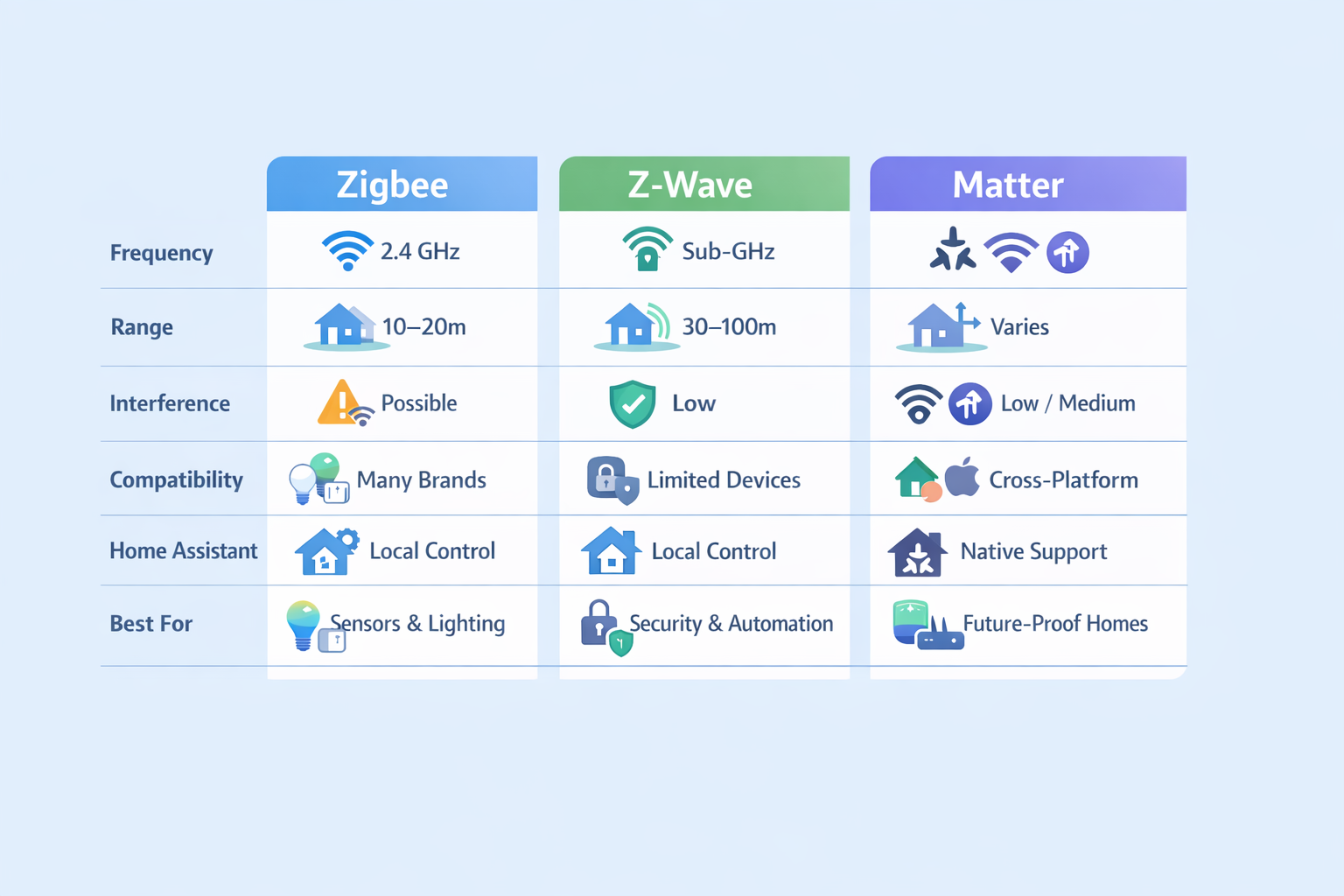
The table below summarises the key differences between the three major smart home protocols.
| Feature | Zigbee | Z‑Wave | Matter |
|---|---|---|---|
| Primary Use | Sensors, bulbs, switches, plugs | Security devices, sensors, switches | Universal smart home standard |
| Connectivity | 2.4 GHz mesh network | 868/915 MHz mesh network | Wi‑Fi, Thread, Ethernet |
| Range | Medium (10–20m indoors) | Long (30–100m indoors) | Varies by transport (Thread = long) |
| Interference | Possible (shares 2.4 GHz with Wi‑Fi) | Low (sub‑GHz band) | Low (Thread), Medium (Wi‑Fi) |
| Device Compatibility | Wide range, many brands | More limited ecosystem | Cross‑brand universal support |
| Home Assistant Support | Excellent (local control) | Excellent (local control) | Excellent (native Matter integration) |
| Hub Required? | Yes (Zigbee coordinator) | Yes (Z‑Wave controller) | Not always (depends on device) |
| Latency | Very low | Very low | Very low (Thread), Medium (Wi‑Fi) |
| Security | AES‑128 encryption | AES‑128 encryption | End‑to‑end encrypted standard |
| Best For | Affordable sensors & lighting | Reliable security & automation | Future‑proof, cross‑platform homes |
Zigbee: Best for Affordable Sensors & Lighting
Zigbee is one of the most popular smart home protocols thanks to its low power usage, fast response times and huge ecosystem of compatible devices. Brands like Aqara, Philips Hue, IKEA Tradfri and Sonoff all use Zigbee, making it ideal for building large sensor‑driven automations.
If you're building a Zigbee‑heavy setup, check out our guide to the best Zigbee sensors in the UK.
Pros & Cons of Zigbee
| Pros | Cons |
|---|---|
| Low power consumption | 2.4 GHz interference possible |
| Large device ecosystem | Brand interoperability varies |
| Excellent Home Assistant support | Requires a Zigbee coordinator |
| Fast, reliable mesh network | Shorter range than Z‑Wave |
Best for: sensors, lighting, budget‑friendly automations.
Z‑Wave: Best for Reliable Security & Long‑Range Devices
Z‑Wave is known for its stability and long indoor range. It operates on sub‑GHz frequencies, meaning it avoids Wi‑Fi interference entirely. Z‑Wave is commonly used in security devices such as door locks, motion sensors and alarms.
For more Z‑Wave recommendations, see our guide to the best Z‑Wave devices for Home Assistant.
Pros & Cons of Z‑Wave
| Pros | Cons |
|---|---|
| Low interference (sub‑GHz) | More expensive devices |
| Longer indoor range | Smaller ecosystem |
| Highly reliable mesh | Requires a Z‑Wave controller |
| Great for security devices | Different regions use different frequencies |
Best for: security systems, long‑range sensors, stable automations.
Matter: Best for Future‑Proof Smart Homes
Matter is the newest smart home standard, designed to unify ecosystems across Apple, Google, Amazon and Home Assistant. Matter devices work locally, support multiple platforms, and offer fast performance when paired with Thread.
If you're building a future‑proof setup, explore the best Matter devices available in the UK.
Pros & Cons of Matter
| Pros | Cons |
|---|---|
| Cross‑brand universal compatibility | Still early in adoption |
| Local control by design | Not all device types supported yet |
| Works over Wi‑Fi, Thread, Ethernet | Thread requires a border router |
| Excellent Home Assistant integration | Some brands have inconsistent support |
Best for: future‑proof setups, mixed ecosystems, Thread‑based networks.
Which Protocol Should You Choose for Home Assistant?
The best protocol depends on your goals:

Choose Zigbee if you want:
- Affordable sensors and switches
- Fast, local automations
- A large ecosystem of devices
- Easy expansion with repeaters
Choose Z‑Wave if you want:
- Maximum reliability
- Long‑range indoor performance
- Strong security device support
- Less interference than Zigbee
Choose Matter if you want:
- Future‑proof smart home devices
- Cross‑platform compatibility
- Fast Thread‑based performance
- Simple setup across ecosystems
Final Verdict
For most Home Assistant users, Zigbee offers the best balance of price, performance and device availability. If you want rock‑solid reliability for security devices, Z‑Wave is the better choice. And if you're building a modern, future‑proof smart home, Matter is the protocol to watch in 2026.
Many advanced Home Assistant setups use a mix of all three — Zigbee for sensors, Z‑Wave for security, and Matter for new devices.
Next, read our guide to the best Home Assistant integrations to expand your automations even further.